Autumn 2013

Autumn 2013
Showing posts with label tee. Show all posts

Sunday, September 1, 2013

Fathers and Daughters

Hello, everybody, and welcome to the Apple Basket!
This week, I will tell you of current goings-on, upcoming events, and as always, knitting and books.

So, last Sunday was a full day. We left home at 6 am and drove to Copenhagen to attend a Baptist service that included the reason for it all: the blessing of Kajsa, the daughter of my cousin Lasse and his wife, Anne.
After that came a sumptuous brunch with the family at Café Sult (= Café Hunger), and then we drove back home. A full day, and a lovely day. And for some reason, we were exhausted by sitting in the car, sitting in the church, sitting and eating, and sitting in the car again. Weird.

I have been to several Baptist services, including a baptism, and they are so much more enjoyable than the regular Lutheran state church services. The physical proximity and modern casual garb of the minister, the live music, the song and psalm texts projected from a MacBook to a screen on the wall, the friendly familiarity and welcoming smiles of people who have never seen you before.
Even an old sceptic like me can feel and partake in the palpable joy and sense of community in the room, particularly on this occasion of welcoming a new child belonging to God, to the parents, to the family, and to the community. I was reminded of the saying ‘it takes a village to raise a child’, as everybody present was asked to support Lasse and Anne in raising their daughter – and maybe this is what it’s all about. Whether there really is a transcendent being holding everybody in his hands is less important than the coming together of caring humans believing in the principles of love, mutual support, and joy.


In the FWG group on LinkedIn, the August short stories are all in, and the votes are cast. Right now, we are waiting for the count, and then will come the feedback in small groups.
Victor joined the group and submitted a story: as soon as I mentioned the August highlights, he had an idea and wrote a story, made a profile and did his thing. I read his story – but I haven’t helped him otherwise: he does it all on his own merits.


We have some upcoming events around here: next weekend, on the 6th – 8th September, the big annual craft fair, Husflidsmessen, takes place in Viborg. I will be going on the Saturday to check out the stalls, mostly for the yarns.

And in a few weeks’ time, on 14th – 21st September, is the Viborg Festival (Festuge) with lots of things going on. On the Thursday is a knit & crochet workshop that I am going to, primarily as a story teller – but I will bring my knitting, of course.


I realised that it’s been a while since I talked about my running; this is not because I haven’t run at all, though it hasn’t been all that much this week. I am up to 5-minute intervals now, with 1-minute breaks and usually a 6-minute run at the end (and, of course, 3 or 4 minutes of cool-down walk).
I am hot when I run – as in ‘too warm’, mind you, not in any sense even remotely approaching ‘sexy’! – so the ambient temperature has a significant impact on my well-being and performance. The summer heat (and yes, around here, 22 C is heat) in July made running tough, and even the 17 C we had this Friday, with an unfulfilled promise of rain in the humid air, was a bit much for me. Today, it is 12 C, grey and wet – and much better. The longer uphill stretches aren’t killing me, and I am even planning 6 or maybe 7 minute intervals for my next run.
We’ll see how that goes; I will be experimenting with running in the afternoon, too, as my teaching on Tuesdays and Wednesdays is from 8 to 12 am, and after driving to and from Aarhus around that, I need air.


The Knitting
With the long drives last Sunday, to Copenhagen and back, and with my dad doing most of the driving, I got quite a bit of knitting done; so I actually finished two things this week. On top of that, I frogged an old hibernating project to re-purpose the yarn. And I didn’t cast on anything new – so my wip count is going down. Yay!

What did I finish, then?
 First, the Charm tee, for which, as it turned out, I had lots of yarn; enough for long sleeves and even some leftover.
Because the hem is curved, I did a stretchy cast-off, the k1, [k1, k2tog] that can be useful for a lace shawl. But that one was too stretchy, making the hem flop outwards, so I undid it and replaced it with the ‘usual’ pulling a stitch over a stitch-method.
I can see, now that I’ve tried it on properly, that if I use this pattern again, I’ll want to move the raglan increase rows a bit towards the centre, leaving more stitches for sleeves.
One more top for work done; with students, I need to be aware of wearing different things, because they notice. I have five usable tops now, one on the way, and two or three more planned.

And I finally finished the striped socks that do NOT take four months to knit, regardless of what the Ravelry project page for them might say – unless, of course, you have 15 other projects running at the same time and only do a stripe or two once in a while.
These toe-up socks have arch-shaping, which I love, hugging the sole of your foot, and an unusual, fitted, short-row heel, as well as (optional) decreases around the ankle.
I am going for a fitted sock that doesn’t bunch inside shoes.

The next phase will be wearing the socks to see how the heel works out; if it is good enough, I will try out the Free Pattern Testers group on Ravelry before releasing the pattern. More on this in due course.
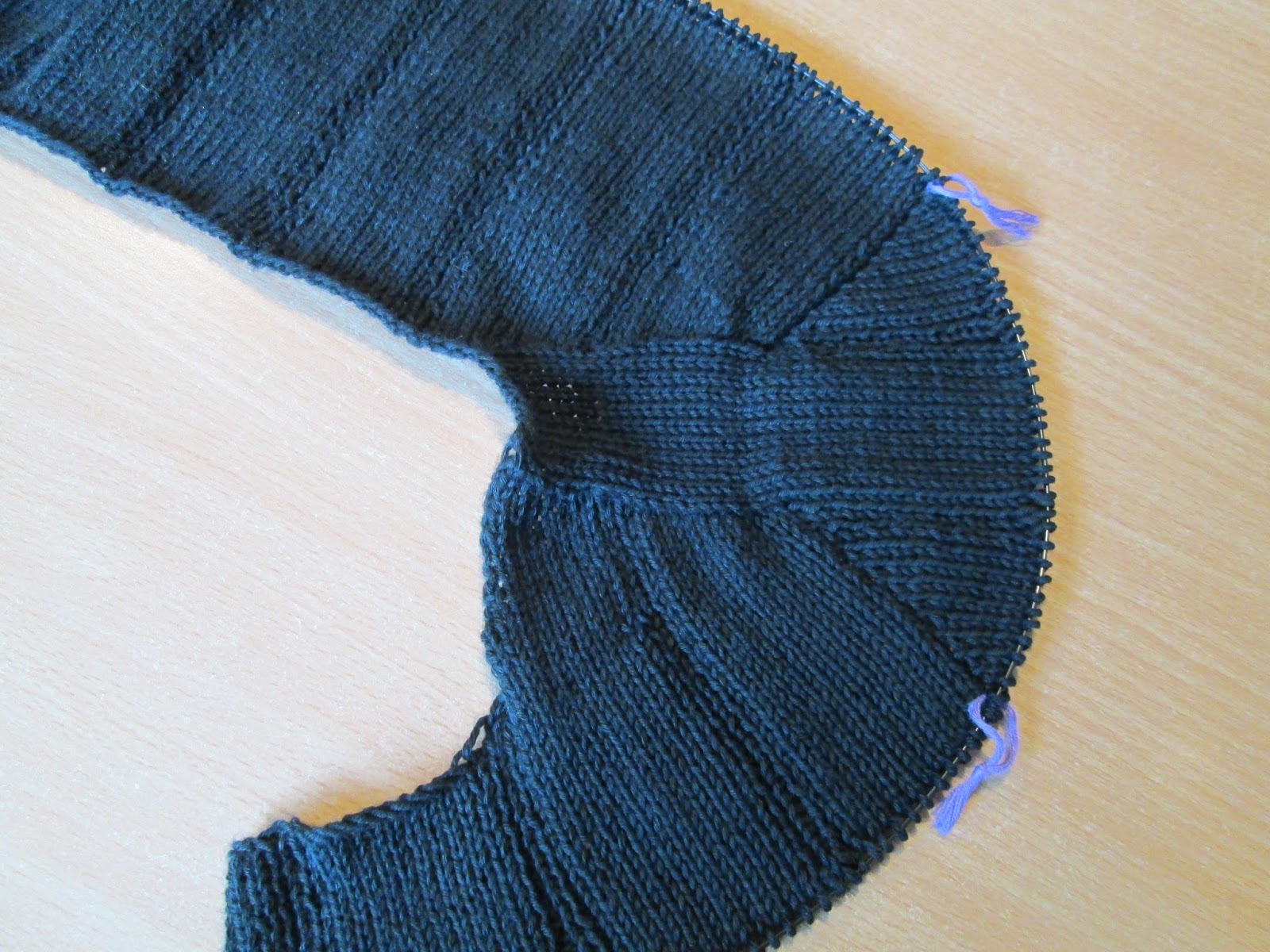
My current main project is a fingering weight cotton cardigan, an adult version of the Laura cardigan. The working title is Leaf cardigan because of the leafy lace border at the bottom – I do intend to come up with something more imaginative.

Anyway, I am once again using the contiguous sleeve method invented by SusieM, but with more shoulder stitches. On the driftwood 
jumper where I first encountered this method, you have two stitches running from the side of the neck to the shoulder, with increases on each side.
Now, that is all well and good – but it makes the back of the neck rather high, and my jumpers have a tendency to creep backwards over the shoulders. So, on the Laura, I made 7 shoulder stitches to give a bit more room for the back of the neck, and on this adult version, I have 11, making the shoulder somewhat resemble a saddle shoulder. The choice of uneven numbers is dictated by the stitch pattern I use for these cardigans: the leaf stem ribs are spaced by 11 knit stitches.

I am almost down to the divide for body and sleeves; the pattern is simple enough to be worked on while reading, so it is coming along nicely.


The Books
As mentioned last week, I have been listening to ChopBard on The Tempest, and of course reading the text of the play.
Apparently, this is a difficult play to pin down – what is it all about? Magic and the use of it, power over yourself and others, crime and retribution, redemption, revenge or forgiveness. As it is a comedy, nobody dies – though several characters are thought to be dead and/or fear for their lives – and a young couple are to be married.
There seems to be a line of critique that focuses on colonialism and slavery, simply because some of the characters are white Europeans (from Milan or Naples), landed on an island in the Mediterranean (not Bermuda) that was formerly only inhabited by the son of a North African witch. And this son, Caliban, is put to hard labour by Prospero, the duke-turned-magician.
I get the sense, once again, that particularly white US citizens want to interpret anything and everything in the light of a collective guilt over having used black Africans as slaves. Not that I would ever condone slavery as such – but it has been widely practised, historically and globally speaking, not only in North America, and not only by white people using black people.
Get over it. Shakespeare was not burdened by this guilt when he wrote his play, for very good reasons, so insisting on this interpretation is a huge anachronism.
And anyway, Caliban is the son of a Tunisian witch, not a Sub-Saharan black African, and he is a convict, not a slave. Prospero is punishing him for the attempted rape of his daughter, Miranda, who at the time of the play is 15 years old. Who can blame a father for that?

I mentioned to my boys what goes on in The Tempest: a storm and a shipwreck, people are thrown ashore on a magical island where strange things happen – and so, we decided to watch Lost again. The whole redemption or forgiveness theme in Shakespeare has resonances in Lost, as well: practically everybody, at least the main characters, are given a second chance to straighten up their lives and come to terms with themselves.

And, by the laws of synchronicity, I finally got started on the August group read in the Ravelry Book Club on Goodreads: The Night Circus by Erin Morgenstern. So, more magic and poetry – this is a lovely book.
The first named character to show up in the book is Prospero the Enchanter – stage name – and next, we meet his daughter who is very explicitly NOT named Miranda. Isn’t that great? See, if I had started this book sooner, say, around the beginning of August, those names would not have resounded the way they did for me.
Sometimes, the universe just aligns.


And on this happy note, I will leave you for now. Have a wonderful week, and I will be back with more chat on knitting, and yarn, and books, and students.
Take care!


Saturday, August 24, 2013

Blessed

Hello, everybody, and welcome once again to the Apple Basket!
This week, we have knitting, books, and Roman history – all very familiar to regular readers, no big surprises there.
I am posting on a Saturday, for once: tomorrow, I am going to a baby blessing. My cousin’s daughter, Kajsa, was born in July, and as they are Baptists, the baptism proper won’t happen until she is old enough to choose it for herself. So for now, there will be a blessing.
Which means that Victor and I, and my parents, are leaving here at 6 a.m. to drive to Copenhagen, meeting my sister along the way so that we can all share a car for the majority of the trip. It’s going to be a long day – but lovely, I’m sure.


The Knitting
My Rondeur tee, renamed Charm, received a substantial boost this week, after I finished all the girly pink things (not that I mind pink once in a while).
I have a bit of reading to do, preparing for term, and so stocking stitch in the round is a suitable occupation for my hands while wading through paragraphs of Latin morphology and syntax accompanying bites of text in the beginners’ compendium.
Anyway, the body of the thing is done, and having yarn left over, I decided to give it sleeves. While it is made in cotton and thus probably not for deep winter, the neckline is fairly high, which means I won’t be wearing it on the hottest days of summer, either. And so, sleeves will make it more useful. I’ve divided the remaining yarn in two, and then we’ll see how much sleeve I get out of it.


The Chemistry Department at the University of Surrey in the UK is doing a knitted-and-crocheted Perovskite crystalline structure project. I’ve mentioned it before, and now I’ve finally gotten around to making one of these little things. I have chosen, unsurprisingly, to knit a blue octahedron rather than crochet a yellow ball. The project is open for contributions until the end of August, so there is still time, if you want to play :o)
Patterns are downloadable, from the website and via Ravelry, for both figures.
Depending on your particular stitch and row gauge, you may want to make the triangles for the octahedron in a slightly different way; ladynthread has a method for bottom-up equilateral triangles.

I went all the way and made two open-bottomed pyramids instead of eight triangles – this way, you only need to sew up the pyramid bases and not all of the sides.
So, here goes:
I used Kauni 8/2 solid, blue yarn left over from my TARDIS, and 4 mm needles.

Cast on 56 sts (or however many you need to make four sides of 7-8 cm each).
Divide sts onto 4 dpns and join to work in the round.
Knit 2 rounds.
On every 3rd round, k3tog in the middle of each dpn: these will be the corners.
NOTE: k3tog: slip 2 sts knit-wise, k1, pass slipped sts over. This makes a nicely defined ridge.
When 2 sts remain on each dpn, ssk impr 4 times (insert RH needle into first st knitwise, into second st tbl, and knit both together as one).
Break yarn, pull thread through remaining 4 sts.

Make one more.
Block.
Cut and tack in card triangles (I used a Weetabix box).
Sew base edges together to form octahedron.
Stuff.

Voila! A quick little project, just for fun.


As I’ve mentioned before, I am going to need work clothes, i.e. neat cardigans and jumpers – we all have our definitions, don’t we?
So, I am setting out to make an adult version of the Laura cardigan, in black cotton to begin with. There is nothing, really, to show off just yet; I cast on for the neckline and realised it was going to be too wide, and then I was distracted by the octahedron that needed some reworking to become properly equilateral.


The Books
Most of my reading this week is about Rome. I know, didn’t see that one coming, did you? :o)

I read the rest of the Philippic Speeches of Cicero, bringing events through the spring of 43 BCE to the point where words were not enough anymore, and civil war was a reality. Again.

Among the invectives against Marcus Antonius and his brothers – Cicero calls Marcus ‘Spartacus’ (yes, the gladiator leader of the slave rebellion in 73 – 71 BCE), refers to Lucius as a myrmillon, another type of gladiator, and repeatedly accuses Gaius of extortion, greed and the like – is evidence that he well knew that his line of politics could get him killed.

Roman politics in general were violent: a basic principle was presence and immediacy, and personal participation was crucial. Proposals were made in speeches in front of the Senate, with the Curia doors open to the outside so that people could hear what was going on. Sometimes one speech was made to the Senate and then another one to the People. Voting was done by physically moving to one side of the hall; the people lined up outside and voted, often immediately, on pressing matters. At times, fights and mini-riots broke out in the crowds; magistrates were shoved and beaten and pelted with stones, physically prevented from protesting or from speaking.

Going up against powerful and violent adversaries was, of course, dangerous, and so, playing an active part in the upper echelons of political society always held the risk of death or exile. Cicero knew this well: he was exiled temporarily in 58, and this situation was even more critical. Indeed, at this point in time, soon after the murder of Caesar, everyone was freshly aware of how lethal politics could be. Some preferred to seek neutral ground and stay out of the fray, but most of the patricians adhered to their noble ancestry and the inherited sense of honour and courage in the face of danger: they would rather face an honourable death than ignominious compromise.

Roman religion was, as Roman life in general, divided into the private and the public spheres: every official act, be it a meeting of the Senate, a People’s Assembly, an election, a declaration of war, a battle – all were preceded by the taking of auspices. Signs and omens were observed or actively sought and then interpreted; if Jupiter thundered in the skies, there could not be an assembly, because that was regarded as a sign of divine displeasure. Thus, auspices were an integral part of politics, and priests were elected from the same body of men as magistrates and military leaders.
Privately, a Roman would sacrifice to his – or her – Lares, household gods, visit various temples or shrines to barter with whichever divinity might give them what they wanted. This was a practical affair, usually described by the phrase do ut des: ‘I give so that you will give’.
For more spiritual needs, one would turn to philosophy, choosing one or a mix of the Greek schools. Stoicism, Cynicism, Epicureanism – take your pick. The benefit of these (I know this is hugely simplified and could easily fill a whole book – or several) was reconciliation with the tumult of life and the prospect of death. Attempting to be less dependent on worldly joys, wealth, comfort, and status, would have been helpful in an uncertain milieu of political assassinations, external & civil wars and proscription.

Cicero was an elected augur, a taker of auspices, as well as a philosophical writer, having – in the years when he was practically excluded from political life – read and translated a number of philosophical texts. To render abstract Greek terms into Latin, he invented a number of words that we know and use today, such as qualitas, quantitas, essentia: quality, quantity, and essence.
Several times during the Philippic Speeches, Cicero returns to the theme that his life may be – and it certainly was – in danger because of his outspokenness against Marcus Antonius; he concludes that he has lived long enough and accomplished enough to ensure his reputation, and thus, he is ready to die.
Now, it is one thing to say this and quite another to live it, so to speak. One could be forgiven for not completely trusting Cicero’s own words, edited by himself after speaking and before publishing, about his courage. But the accounts of Cicero’s death show him accepting his fate with equanimity, calmly stretching his head out of the wagon when Marcus Antonius’ henchmen caught up with him.
Cicero was killed in December 43, 63 years old.


I am still reading The First Man in Rome by Colleen McCullough, the first book in the series Masters of Rome. The ‘First Man’ of the title is Gaius Marius who rose from being an outsider to being virtually the leader of Rome – though not quite, as the phrase implies, a primus inter pares: first among equals. Marius was a homo novus, a new man not belonging to any of the old patrician or plebeian families of the city proper. So many members of the old families refused to recognise him as a worthy participant in the political game; and yet, he managed to be elected consul no less than seven times. Under normal rules, this would only be possible if a man lived to be over 100 years old: the minimum age was 42, and ten years had to pass between two terms as consul.
But Marius was elected – in absentia, no less – in five consecutive years. The reason why he was away from Rome, and why he was needed to stay in power, was the threat of a huge Germanic invasion: about 800,000 people from three tribes had wandered Europe for decades and wanted a nice, warm homeland instead of going back north to where they came from. And Marius was the only military leader capable of organising the repulsion and defeat of this river of bodies.

It’s not at all because the book is boring that it’s taking me so long – it is a long book, nearly 900 pages, and I can’t read for four hours a day, no matter what Stephen King says (which is: read four hours a day and write four hours a day), at least not in a single book.

And besides, I need to re-read the beginners’ book I am going to inflict on my students soon. This is a Danish set of two books, one containing texts, glossary, and texts in Danish on the realia in the Latin text; and a second book containing all of the grammar, morphology, syntax, and exercises. It is called Vita Romana, the Roman Life; and as it is out of print, we’ve had it scanned so that the students can print it themselves. This, of course, leaves all of us with a bunch of papers, but never mind. The students can write notes in the margins without any worries, so that is all well and good.
The progression in the texts is logical and well-founded; of course they will have a steep learning curve, but that never killed anybody, so I am not worried. Yet.


On the listening front, I am continuing with two books I have mentioned already: Age of Innocence on CraftLit, read in the mellow tones of Brenda Dayne (of Cast On podcast fame), and commented on by the ever erudite Heather Ordover.

Once in a while, I get to listen to a section of A Tale For the Time Being by Ruth Ozeki, the story of the writer Ruth who finds a parcel washed ashore near her home in British Columbia, that turns out to contain the diary of a 16-year old Japanese girl, Nao. The narrative follows Ruth, as she reads the diary, interspersed with her investigations of the facts presented in it – if they are facts – and her use of this investigation to procrastinate the writing of her own memoir.
Ruth’s husband, Oliver, and the cat, Pest or Pesto, play their own parts in the unfolding of the mystery.

The reason why I only intermittently listen to A Tale For the Time Being is that it is one of the Audible swaps from my sister, and those I cannot move into my phone; I have to listen from the laptop. So, I usually have several audio books running, when I’m not catching up on podcasts: one on the laptop for sitting down and knitting (or, when I’m home alone, I can listen via speakers), and one on the phone for on-the-go listening. I have gathered a collection of them to listen to, via the app, while driving to and from Aarhus, about an hour each way, three times a week during the semester.

Right now, though, I am back with Shakespeare and the ChopBard podcast, a bunch of episodes from 2010 dealing with The Tempest. And once again, I highly recommend this podcast to anyone interested in Shakespeare.
The Tempest is the play set on the island with the magician and his daughter, the spirit servant and the convict – and the shipwreck in the beginning, caused by, well, the tempest. I have never read or seen this play before, so I have no idea how it unfolds, let alone ends. The names Prospero, Miranda, Ariel and Caliban, though, have filtered through into the pool of often heard but never properly known names of Shakespeare characters, so it is good to finally get the back story to them.


Well, that’s it for now – I will be back next week with more.
Until then: have a great week!