Autumn 2013

Autumn 2013
Showing posts with label baby. Show all posts

Sunday, September 8, 2013

A bit of this, a bit of that

Hello, everybody, and welcome to the Apple Basket!
This has been a full week – I started teaching my two classes at university, which meant getting up quite early on Tuesday and Wednesday, driving an hour (or more, depending on traffic) each way, coming home late on Friday, and meeting 40 new people all at once.
Needless to say, when I got home on Tuesday afternoon, I was knackered. There’s no other word for it. Happily, it is already getting better: gradually coming to know these new students is less taxing than meeting them for the first time, and I am easing back into teaching mode. Plus, the subject matter is, if not limited, then at least cohesive.

It’s all about Latin: grammar – very basic grammar, at first, as some of the students have no clue – words, the structure of the language and how it works to express all the variety of the natural, human, and divine world. This awareness of language is new to some of them and needs to be deepened for all of them.
I do enjoy expanding their horizons; someone once said that when he was a student in the late 60s, a lot of young people took mind-enhancing drugs – while he read Latin. Which can be somewhat safer.

The bits of text are, for now, construed by Latin teachers; later, we will read ‘real’ texts by actual Romans. So, there is content to deal with, as well, and I get lots of chances to digress into the history, culture, and mindset of the Romans; at least, I can introduce themes that they will be able to explore further later on.


With the job being part-time, I do have a life outside of it, including my writing. The FWG August Short Story votes were counted and came back last Sunday – and this time, my story achieved seventh place. So, it did get some critical acclaim :o)
And a reminder from the feedback group to use more dialogue; I’ll have to not only be aware of that, but actually do something about it in the September story.
Anyway, here it is:

The Countryman

I always knew that I should be king.
Even when we were boys, it was obvious to me that my brother’s claim to the throne was merely an accident of his being born first. He was meek, sweet, forever seeking approval and friendship, love. Too weak to rule.
Not even as king did he endeavour to impose fear and respect on others, mark his territory, so to speak. He sought alliances, preferred diplomacy to battle. Diplomacy can be useful, of course, honeyed words and gifts to lull the opponent; but never should it be the end, only the means to the true end.
This could not go on: our position was gradually weakened, others saw us as an easy target, land to be conquered. My brother would not listen to me.

So I had to prove my point. I am stronger, more fit to rule.
I did not kill him or have him killed. That would have brought down the wrath of the gods on my head; I merely placed him under house arrest end even let his wife follow him. They told me his brat was killed in the melee, though I never saw the corpse.

For fifteen years now, I have had it all. The power, the title, the riches. My wife and my daughters adorn their hair with ribbons of the finest Tyrian purple. They wear gold bracelets and pearl earrings. And Akastos is growing up to be a handsome heir. I did prove my point.

Lately, though, strange things have begun to happen.
Thunderclouds gathered out of nowhere. White-hot lightning flashed purple against the greenish grey clouds and struck the old olive tree in the courtyard, my favourite shady spot for resting in the hot afternoons. The dry wood caught flame, and the whole tree burned down in an instant. Nothing else was struck, and the clouds dissipated and blew away, leaving a clear blue sky. As if nothing had happened. Only my olive tree was gone, reduced to ashes dancing on the breeze.
It must be an omen. Something bad is coming for me.

I arranged sacrifices to all of the gods, though I have done nothing wrong. Even Hera, the old hag, must have her due. It will not do to be at odds with the immortals.

There is an old prophecy about me: a man from the country, wearing only one sandal, will bring me down. It was uttered long ago, before I had anything worth bringing down, and for many years, I have paid it no heed. But suddenly, it comes to my mind.
I have to watch those around me. But it is ridiculous: nobody walks around wearing a single sandal – those who are too poor simply go barefoot.

Next, a shepherd came back alone from the pasture, claiming that a lion had attacked the flock. Highly unusual for this time of year. Several sheep were indeed found dead or injured so badly that they had to be put down; and the shepherd’s boy had been mauled and killed, too. The shepherd was of course interrogated, but found to have done nothing wrong.
And he was wearing both his sandals.

I find myself waking in the nights, plagued by thoughts that have no meaning. Strange ideas come to me. What if my brother’s son, Jason, was not killed all those years ago? What if he was whisked away, like a boy in the stories, to grow up anonymously and return to avenge his father’s ignominious fate? To claim his inheritance and ruin all that I have worked for?
But no, this is ridiculous.

I can tell no-one about these thoughts. They would think I was going mad, would find me weak and vulnerable. Not even Akastos can be trusted with the secret: he was too young when it all happened, and knows nothing of his cousin. His dead cousin.

...

I have arranged a feast, a great sacrifice. A hundred heifers are to be slaughtered. This will show my generosity to all, gods and men alike.
For some reason, the great fire for the burn-offerings won’t catch. While the attendants struggle with the kindling, a murmur ripples through the crowd, and it parts. Everybody falls silent, as a young man approaches, dripping wet and wearing only one sandal.

The sky blackens, and the ocean roars in my ears.

The young man walks calmly through the crowd, straight towards me.
‘Greetings, uncle,’ he says.

...

The next day, I summoned Jason. I knew how to get rid of him without seeming to: I reminded him of the fleece of the golden ram, brought to faraway Aia by our uncle Frixos. This fleece, and its power to bring prosperity to the land, rightly belongs here, and the recent row of misfortunes plainly shows how we need it.
‘I am too old now for heroic journeys,’ I said. ‘Your country needs you.’
‘You are young and as yet unknown to the people,’ I told him. ‘But if you bring back the Fleece, you will have proved your worth, and they will welcome you as king.’

He acquiesced and immediately set about procuring a ship and gathering a crew.
This morning, they went away. My relief flowed into hearty emulations of wishes for their journey and safe return, as I watched them embark and set sail.

He will never return: the journey to the ends of the world is perilous, and the king of Aia has no love for strangers. If they make it there alive, he will see to it that they never leave.

I am safe, my position is once more secure. I call for Akastos; he is old enough now to be taken further into my confidence, to learn the intricacies of ruling.
But there is no answer – where is he?

© 2013 Dorthe Møller Christensen


The Knitting
Knitting for babies is always a bit of a gamble, size-wise: you want the garment to fit within the foreseeable future, but not be outgrown too quickly, either. And, say, a lacy cotton cardigan should preferably be useful while the weather is still warm enough.
So, the parents have been waiting for just the right moment to put little Kajsa into the Elanor cardigan, and this is what happened:
Adorable, isn't she?

This weekend, the big annual craft fair, Husflidsmessen, takes place in Viborg. They don’t allow photography, so imagine two big sports or concert arenas sitting across from one another, each filled to the brim with stands from a range of shops and clubs showing and selling yarns for knitting and crochet, buttons, tatting, weaving, felting, woodwork, amber, beads and jewellery making, paper cutting, patchwork sewing and quilting, glass blowing, Christmas decorations (including mead and mustard in stone jars), and more.

The ‘streets’ between the stands are thronged with people, the majority of whom are mature ladies – though the shoppers come in all ages, sizes, and shapes. You don’t see many children, which is a blessing for both the children and everybody else: the couple of kids I saw looked as if they had been dragged there by their mother and grandmother and couldn’t wait to escape.

My sister and I left our children at home, to browse in peace – or as much peace as you can get in the crowds. Each of us had plans, something we wanted to look for; I had more luck with mine, but we both managed to buy stuff.
My sister got connectors for the KnitPro interchangeable circular needle wires – those things make life so much easier when you need to try something on: instead of having to transfer all the stitches to a piece of yarn, try on your thing, and then put all the stitches back before knitting on, you can screw on another length of wire, and Bob’s your uncle. (I am feeling the lack of this option right now for the Leaf cardigan that still hasn’t got a better name and is worked on 2.5 mm needles, that don’t come as interchangeables.)

We both got beads for stitch markers – the elephants didn’t want to be stitch markers, though, so they became earrings instead.


And yarn, of course. I only bought yarn for planned projects, no questionable spur-of-the-moment spree-shopping.
So, variegated Kauni for a dress – and yes, they are all the same colourway, the EZ:


Gloriously soft cashmere alpaca from Sandnes for little warm things:


And something else that is a secret for now - I’ll show you later.
(Sorry about the pics, I don't know why they have tilted.) 

So much for this year’s craft outings: we did Saltum in May, and now this one in September.

As mentioned above, I am working diligently on my Leaf cardigan – all this running about, though, and going off to Aarhus several times a week, is cutting into my knitting time. Quite annoying. I’m still figuring out a new equilibrium on that front, as well as trying to work out how to fit in pattern writing at times when my brain isn’t threatening to go on strike.
Anyway, I am below the sleeve/body divide now and just ploughing on down towards the lace border; so it is a bit boring at times. It works for watching Lost, though, and even reading (I suppose so, at least, haven’t had a chance to try it out).


The Books
I have almost finished The Night Circus by Erin Morgenstern, the August group read in the Ravelry group on Goodreads. This is one of those books where you want to read on to see what happens – and at the same time, you don’t want to reach the end of the book, because then, well, it ends. The beauty of consuming books, though, is that they stay with you, once you’ve read them. So in that sense, a book never really ends, but becomes part of your inner landscape – and this particular feature of the landscape is one to be treasured.

At some point in the book, a shawl shows up – well, several shawls, actually, at several points, but there is one in particular that caught my attention. It is described as ‘a length of ivory lace’ and belongs to one of the protagonists, Miss Celia Bowen.
You have guessed it already, haven’t you: I am going to have to make this shawl. I don’t know when it will be, but the thought is simmering quietly in my mind ...
And, if you know the book, you can also guess why I was drawn to the red cashmere alpaca and not, say, purple, as I would usually be.
So watch this space :o)

All this driving gives me ample time to listen to books, and I have been compiling audio books via the Audible app on my Android smart phone. Too much detail? Well, I’ve been listening to From Gutenberg to Zuckerberg: What You Really Need to Know about the Internet by John Naughton. The book pretty much does what it says on the tin: it presents a history of the Internet, the Web (which are not the same), and a bunch of technologies relating to the Internet, as well as comparing the possible, as yet unknown, impact of all these new modes of communication with the advent of the printing press in the 15th century.
I had one quibble: when presenting one of the consequences of printing, the personal authorship as opposed to the scribal times’ copy-and-comment mode, Naughton gives the French essayist Montaigne the credit for inventing the personal essay – thereby completely ignoring Seneca and the whole antique epistula tradition.
That may be a minor point, though, and on the whole, I found the book both informative and useful.

My next and current listening adventure is the September group read in the Goodreads Ravelry group: Three Bags Full by Leonie Swann, read by Hugh Lee. (There is a point to mentioning this, as one US listener was unhappy with a female reader, and Audible.com offers both versions. I haven’t heard the other one, so I can’t comment on it.)
This is a classic whodunit in the style of Agatha Christie – only with sheep as the main characters. The mystery opens with the discovery of the murdered shepherd, and the sheep, prompted by the cleverest of them, Miss Maple (sic), attempt to solve the murder.
Several readers in the group are unimpressed by talking sheep – but I love it: they are silly and yet wise, forming their own views of the world, of humans, and the events that unfold around them, all from a sheepy perspective. Is it morally defendable, for instance, for an Irish shepherd to choose Norwegian wool for his sweaters?
And the reader makes voices for the sheep and a convincing – to my ears, at least – Irish brogue for the humans. So, a completely different book from the August offering, but fun.


Well, that’s it for this week – thank you for stopping by!
I will be back next week; until then: take care, have a lovely week, and have fun!


Sunday, September 1, 2013

Fathers and Daughters

Hello, everybody, and welcome to the Apple Basket!
This week, I will tell you of current goings-on, upcoming events, and as always, knitting and books.

So, last Sunday was a full day. We left home at 6 am and drove to Copenhagen to attend a Baptist service that included the reason for it all: the blessing of Kajsa, the daughter of my cousin Lasse and his wife, Anne.
After that came a sumptuous brunch with the family at Café Sult (= Café Hunger), and then we drove back home. A full day, and a lovely day. And for some reason, we were exhausted by sitting in the car, sitting in the church, sitting and eating, and sitting in the car again. Weird.

I have been to several Baptist services, including a baptism, and they are so much more enjoyable than the regular Lutheran state church services. The physical proximity and modern casual garb of the minister, the live music, the song and psalm texts projected from a MacBook to a screen on the wall, the friendly familiarity and welcoming smiles of people who have never seen you before.
Even an old sceptic like me can feel and partake in the palpable joy and sense of community in the room, particularly on this occasion of welcoming a new child belonging to God, to the parents, to the family, and to the community. I was reminded of the saying ‘it takes a village to raise a child’, as everybody present was asked to support Lasse and Anne in raising their daughter – and maybe this is what it’s all about. Whether there really is a transcendent being holding everybody in his hands is less important than the coming together of caring humans believing in the principles of love, mutual support, and joy.


In the FWG group on LinkedIn, the August short stories are all in, and the votes are cast. Right now, we are waiting for the count, and then will come the feedback in small groups.
Victor joined the group and submitted a story: as soon as I mentioned the August highlights, he had an idea and wrote a story, made a profile and did his thing. I read his story – but I haven’t helped him otherwise: he does it all on his own merits.


We have some upcoming events around here: next weekend, on the 6th – 8th September, the big annual craft fair, Husflidsmessen, takes place in Viborg. I will be going on the Saturday to check out the stalls, mostly for the yarns.

And in a few weeks’ time, on 14th – 21st September, is the Viborg Festival (Festuge) with lots of things going on. On the Thursday is a knit & crochet workshop that I am going to, primarily as a story teller – but I will bring my knitting, of course.


I realised that it’s been a while since I talked about my running; this is not because I haven’t run at all, though it hasn’t been all that much this week. I am up to 5-minute intervals now, with 1-minute breaks and usually a 6-minute run at the end (and, of course, 3 or 4 minutes of cool-down walk).
I am hot when I run – as in ‘too warm’, mind you, not in any sense even remotely approaching ‘sexy’! – so the ambient temperature has a significant impact on my well-being and performance. The summer heat (and yes, around here, 22 C is heat) in July made running tough, and even the 17 C we had this Friday, with an unfulfilled promise of rain in the humid air, was a bit much for me. Today, it is 12 C, grey and wet – and much better. The longer uphill stretches aren’t killing me, and I am even planning 6 or maybe 7 minute intervals for my next run.
We’ll see how that goes; I will be experimenting with running in the afternoon, too, as my teaching on Tuesdays and Wednesdays is from 8 to 12 am, and after driving to and from Aarhus around that, I need air.


The Knitting
With the long drives last Sunday, to Copenhagen and back, and with my dad doing most of the driving, I got quite a bit of knitting done; so I actually finished two things this week. On top of that, I frogged an old hibernating project to re-purpose the yarn. And I didn’t cast on anything new – so my wip count is going down. Yay!

What did I finish, then?
 First, the Charm tee, for which, as it turned out, I had lots of yarn; enough for long sleeves and even some leftover.
Because the hem is curved, I did a stretchy cast-off, the k1, [k1, k2tog] that can be useful for a lace shawl. But that one was too stretchy, making the hem flop outwards, so I undid it and replaced it with the ‘usual’ pulling a stitch over a stitch-method.
I can see, now that I’ve tried it on properly, that if I use this pattern again, I’ll want to move the raglan increase rows a bit towards the centre, leaving more stitches for sleeves.
One more top for work done; with students, I need to be aware of wearing different things, because they notice. I have five usable tops now, one on the way, and two or three more planned.

And I finally finished the striped socks that do NOT take four months to knit, regardless of what the Ravelry project page for them might say – unless, of course, you have 15 other projects running at the same time and only do a stripe or two once in a while.
These toe-up socks have arch-shaping, which I love, hugging the sole of your foot, and an unusual, fitted, short-row heel, as well as (optional) decreases around the ankle.
I am going for a fitted sock that doesn’t bunch inside shoes.

The next phase will be wearing the socks to see how the heel works out; if it is good enough, I will try out the Free Pattern Testers group on Ravelry before releasing the pattern. More on this in due course.

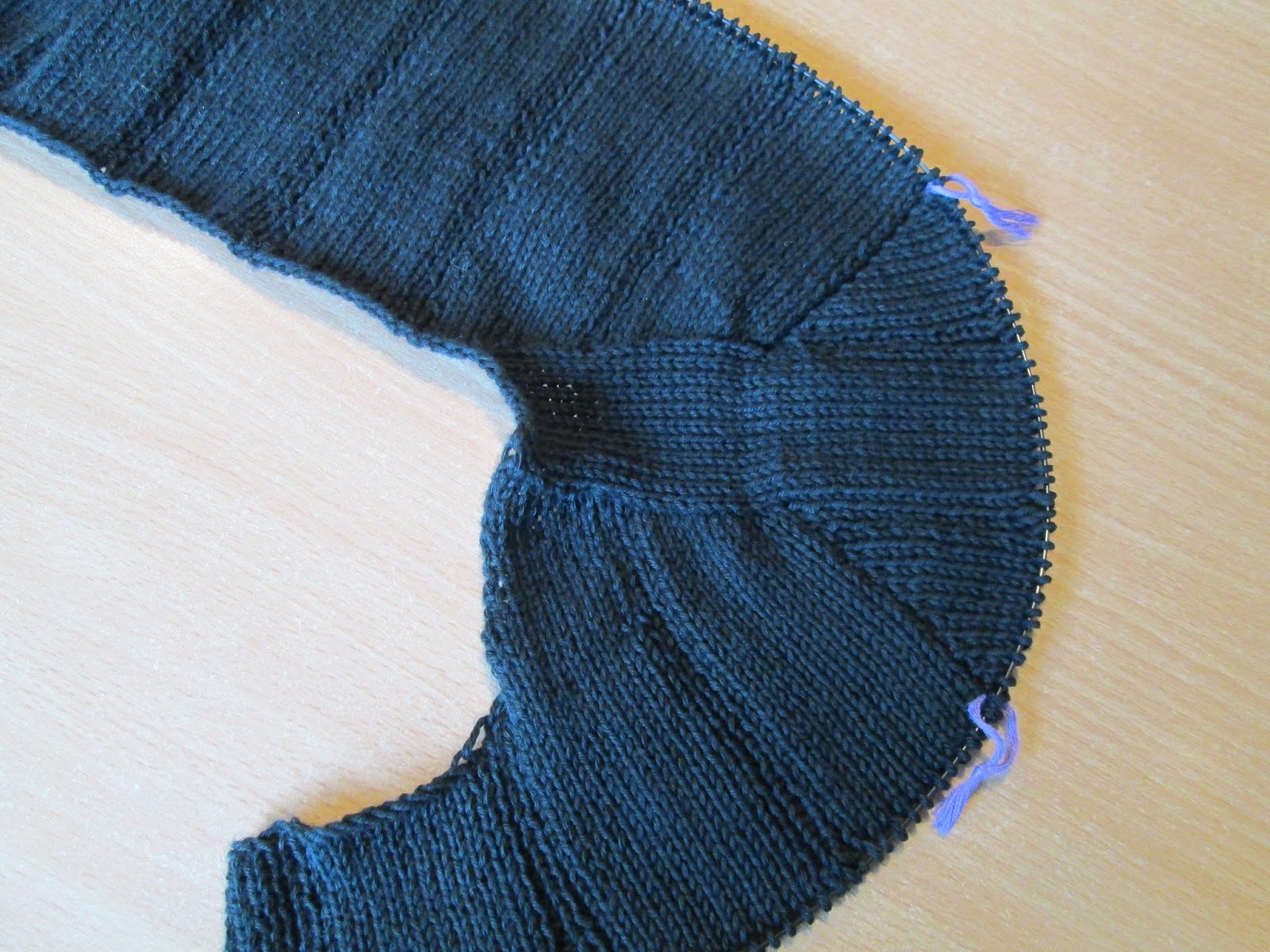
My current main project is a fingering weight cotton cardigan, an adult version of the Laura cardigan. The working title is Leaf cardigan because of the leafy lace border at the bottom – I do intend to come up with something more imaginative.

Anyway, I am once again using the contiguous sleeve method invented by SusieM, but with more shoulder stitches. On the driftwood 
jumper where I first encountered this method, you have two stitches running from the side of the neck to the shoulder, with increases on each side.
Now, that is all well and good – but it makes the back of the neck rather high, and my jumpers have a tendency to creep backwards over the shoulders. So, on the Laura, I made 7 shoulder stitches to give a bit more room for the back of the neck, and on this adult version, I have 11, making the shoulder somewhat resemble a saddle shoulder. The choice of uneven numbers is dictated by the stitch pattern I use for these cardigans: the leaf stem ribs are spaced by 11 knit stitches.

I am almost down to the divide for body and sleeves; the pattern is simple enough to be worked on while reading, so it is coming along nicely.


The Books
As mentioned last week, I have been listening to ChopBard on The Tempest, and of course reading the text of the play.
Apparently, this is a difficult play to pin down – what is it all about? Magic and the use of it, power over yourself and others, crime and retribution, redemption, revenge or forgiveness. As it is a comedy, nobody dies – though several characters are thought to be dead and/or fear for their lives – and a young couple are to be married.
There seems to be a line of critique that focuses on colonialism and slavery, simply because some of the characters are white Europeans (from Milan or Naples), landed on an island in the Mediterranean (not Bermuda) that was formerly only inhabited by the son of a North African witch. And this son, Caliban, is put to hard labour by Prospero, the duke-turned-magician.
I get the sense, once again, that particularly white US citizens want to interpret anything and everything in the light of a collective guilt over having used black Africans as slaves. Not that I would ever condone slavery as such – but it has been widely practised, historically and globally speaking, not only in North America, and not only by white people using black people.
Get over it. Shakespeare was not burdened by this guilt when he wrote his play, for very good reasons, so insisting on this interpretation is a huge anachronism.
And anyway, Caliban is the son of a Tunisian witch, not a Sub-Saharan black African, and he is a convict, not a slave. Prospero is punishing him for the attempted rape of his daughter, Miranda, who at the time of the play is 15 years old. Who can blame a father for that?

I mentioned to my boys what goes on in The Tempest: a storm and a shipwreck, people are thrown ashore on a magical island where strange things happen – and so, we decided to watch Lost again. The whole redemption or forgiveness theme in Shakespeare has resonances in Lost, as well: practically everybody, at least the main characters, are given a second chance to straighten up their lives and come to terms with themselves.

And, by the laws of synchronicity, I finally got started on the August group read in the Ravelry Book Club on Goodreads: The Night Circus by Erin Morgenstern. So, more magic and poetry – this is a lovely book.
The first named character to show up in the book is Prospero the Enchanter – stage name – and next, we meet his daughter who is very explicitly NOT named Miranda. Isn’t that great? See, if I had started this book sooner, say, around the beginning of August, those names would not have resounded the way they did for me.
Sometimes, the universe just aligns.


And on this happy note, I will leave you for now. Have a wonderful week, and I will be back with more chat on knitting, and yarn, and books, and students.
Take care!


Saturday, August 24, 2013

Blessed

Hello, everybody, and welcome once again to the Apple Basket!
This week, we have knitting, books, and Roman history – all very familiar to regular readers, no big surprises there.
I am posting on a Saturday, for once: tomorrow, I am going to a baby blessing. My cousin’s daughter, Kajsa, was born in July, and as they are Baptists, the baptism proper won’t happen until she is old enough to choose it for herself. So for now, there will be a blessing.
Which means that Victor and I, and my parents, are leaving here at 6 a.m. to drive to Copenhagen, meeting my sister along the way so that we can all share a car for the majority of the trip. It’s going to be a long day – but lovely, I’m sure.


The Knitting
My Rondeur tee, renamed Charm, received a substantial boost this week, after I finished all the girly pink things (not that I mind pink once in a while).
I have a bit of reading to do, preparing for term, and so stocking stitch in the round is a suitable occupation for my hands while wading through paragraphs of Latin morphology and syntax accompanying bites of text in the beginners’ compendium.
Anyway, the body of the thing is done, and having yarn left over, I decided to give it sleeves. While it is made in cotton and thus probably not for deep winter, the neckline is fairly high, which means I won’t be wearing it on the hottest days of summer, either. And so, sleeves will make it more useful. I’ve divided the remaining yarn in two, and then we’ll see how much sleeve I get out of it.


The Chemistry Department at the University of Surrey in the UK is doing a knitted-and-crocheted Perovskite crystalline structure project. I’ve mentioned it before, and now I’ve finally gotten around to making one of these little things. I have chosen, unsurprisingly, to knit a blue octahedron rather than crochet a yellow ball. The project is open for contributions until the end of August, so there is still time, if you want to play :o)
Patterns are downloadable, from the website and via Ravelry, for both figures.
Depending on your particular stitch and row gauge, you may want to make the triangles for the octahedron in a slightly different way; ladynthread has a method for bottom-up equilateral triangles.

I went all the way and made two open-bottomed pyramids instead of eight triangles – this way, you only need to sew up the pyramid bases and not all of the sides.
So, here goes:
I used Kauni 8/2 solid, blue yarn left over from my TARDIS, and 4 mm needles.

Cast on 56 sts (or however many you need to make four sides of 7-8 cm each).
Divide sts onto 4 dpns and join to work in the round.
Knit 2 rounds.
On every 3rd round, k3tog in the middle of each dpn: these will be the corners.
NOTE: k3tog: slip 2 sts knit-wise, k1, pass slipped sts over. This makes a nicely defined ridge.
When 2 sts remain on each dpn, ssk impr 4 times (insert RH needle into first st knitwise, into second st tbl, and knit both together as one).
Break yarn, pull thread through remaining 4 sts.

Make one more.
Block.
Cut and tack in card triangles (I used a Weetabix box).
Sew base edges together to form octahedron.
Stuff.

Voila! A quick little project, just for fun.


As I’ve mentioned before, I am going to need work clothes, i.e. neat cardigans and jumpers – we all have our definitions, don’t we?
So, I am setting out to make an adult version of the Laura cardigan, in black cotton to begin with. There is nothing, really, to show off just yet; I cast on for the neckline and realised it was going to be too wide, and then I was distracted by the octahedron that needed some reworking to become properly equilateral.


The Books
Most of my reading this week is about Rome. I know, didn’t see that one coming, did you? :o)

I read the rest of the Philippic Speeches of Cicero, bringing events through the spring of 43 BCE to the point where words were not enough anymore, and civil war was a reality. Again.

Among the invectives against Marcus Antonius and his brothers – Cicero calls Marcus ‘Spartacus’ (yes, the gladiator leader of the slave rebellion in 73 – 71 BCE), refers to Lucius as a myrmillon, another type of gladiator, and repeatedly accuses Gaius of extortion, greed and the like – is evidence that he well knew that his line of politics could get him killed.

Roman politics in general were violent: a basic principle was presence and immediacy, and personal participation was crucial. Proposals were made in speeches in front of the Senate, with the Curia doors open to the outside so that people could hear what was going on. Sometimes one speech was made to the Senate and then another one to the People. Voting was done by physically moving to one side of the hall; the people lined up outside and voted, often immediately, on pressing matters. At times, fights and mini-riots broke out in the crowds; magistrates were shoved and beaten and pelted with stones, physically prevented from protesting or from speaking.

Going up against powerful and violent adversaries was, of course, dangerous, and so, playing an active part in the upper echelons of political society always held the risk of death or exile. Cicero knew this well: he was exiled temporarily in 58, and this situation was even more critical. Indeed, at this point in time, soon after the murder of Caesar, everyone was freshly aware of how lethal politics could be. Some preferred to seek neutral ground and stay out of the fray, but most of the patricians adhered to their noble ancestry and the inherited sense of honour and courage in the face of danger: they would rather face an honourable death than ignominious compromise.

Roman religion was, as Roman life in general, divided into the private and the public spheres: every official act, be it a meeting of the Senate, a People’s Assembly, an election, a declaration of war, a battle – all were preceded by the taking of auspices. Signs and omens were observed or actively sought and then interpreted; if Jupiter thundered in the skies, there could not be an assembly, because that was regarded as a sign of divine displeasure. Thus, auspices were an integral part of politics, and priests were elected from the same body of men as magistrates and military leaders.
Privately, a Roman would sacrifice to his – or her – Lares, household gods, visit various temples or shrines to barter with whichever divinity might give them what they wanted. This was a practical affair, usually described by the phrase do ut des: ‘I give so that you will give’.
For more spiritual needs, one would turn to philosophy, choosing one or a mix of the Greek schools. Stoicism, Cynicism, Epicureanism – take your pick. The benefit of these (I know this is hugely simplified and could easily fill a whole book – or several) was reconciliation with the tumult of life and the prospect of death. Attempting to be less dependent on worldly joys, wealth, comfort, and status, would have been helpful in an uncertain milieu of political assassinations, external & civil wars and proscription.

Cicero was an elected augur, a taker of auspices, as well as a philosophical writer, having – in the years when he was practically excluded from political life – read and translated a number of philosophical texts. To render abstract Greek terms into Latin, he invented a number of words that we know and use today, such as qualitas, quantitas, essentia: quality, quantity, and essence.
Several times during the Philippic Speeches, Cicero returns to the theme that his life may be – and it certainly was – in danger because of his outspokenness against Marcus Antonius; he concludes that he has lived long enough and accomplished enough to ensure his reputation, and thus, he is ready to die.
Now, it is one thing to say this and quite another to live it, so to speak. One could be forgiven for not completely trusting Cicero’s own words, edited by himself after speaking and before publishing, about his courage. But the accounts of Cicero’s death show him accepting his fate with equanimity, calmly stretching his head out of the wagon when Marcus Antonius’ henchmen caught up with him.
Cicero was killed in December 43, 63 years old.


I am still reading The First Man in Rome by Colleen McCullough, the first book in the series Masters of Rome. The ‘First Man’ of the title is Gaius Marius who rose from being an outsider to being virtually the leader of Rome – though not quite, as the phrase implies, a primus inter pares: first among equals. Marius was a homo novus, a new man not belonging to any of the old patrician or plebeian families of the city proper. So many members of the old families refused to recognise him as a worthy participant in the political game; and yet, he managed to be elected consul no less than seven times. Under normal rules, this would only be possible if a man lived to be over 100 years old: the minimum age was 42, and ten years had to pass between two terms as consul.
But Marius was elected – in absentia, no less – in five consecutive years. The reason why he was away from Rome, and why he was needed to stay in power, was the threat of a huge Germanic invasion: about 800,000 people from three tribes had wandered Europe for decades and wanted a nice, warm homeland instead of going back north to where they came from. And Marius was the only military leader capable of organising the repulsion and defeat of this river of bodies.

It’s not at all because the book is boring that it’s taking me so long – it is a long book, nearly 900 pages, and I can’t read for four hours a day, no matter what Stephen King says (which is: read four hours a day and write four hours a day), at least not in a single book.

And besides, I need to re-read the beginners’ book I am going to inflict on my students soon. This is a Danish set of two books, one containing texts, glossary, and texts in Danish on the realia in the Latin text; and a second book containing all of the grammar, morphology, syntax, and exercises. It is called Vita Romana, the Roman Life; and as it is out of print, we’ve had it scanned so that the students can print it themselves. This, of course, leaves all of us with a bunch of papers, but never mind. The students can write notes in the margins without any worries, so that is all well and good.
The progression in the texts is logical and well-founded; of course they will have a steep learning curve, but that never killed anybody, so I am not worried. Yet.


On the listening front, I am continuing with two books I have mentioned already: Age of Innocence on CraftLit, read in the mellow tones of Brenda Dayne (of Cast On podcast fame), and commented on by the ever erudite Heather Ordover.

Once in a while, I get to listen to a section of A Tale For the Time Being by Ruth Ozeki, the story of the writer Ruth who finds a parcel washed ashore near her home in British Columbia, that turns out to contain the diary of a 16-year old Japanese girl, Nao. The narrative follows Ruth, as she reads the diary, interspersed with her investigations of the facts presented in it – if they are facts – and her use of this investigation to procrastinate the writing of her own memoir.
Ruth’s husband, Oliver, and the cat, Pest or Pesto, play their own parts in the unfolding of the mystery.

The reason why I only intermittently listen to A Tale For the Time Being is that it is one of the Audible swaps from my sister, and those I cannot move into my phone; I have to listen from the laptop. So, I usually have several audio books running, when I’m not catching up on podcasts: one on the laptop for sitting down and knitting (or, when I’m home alone, I can listen via speakers), and one on the phone for on-the-go listening. I have gathered a collection of them to listen to, via the app, while driving to and from Aarhus, about an hour each way, three times a week during the semester.

Right now, though, I am back with Shakespeare and the ChopBard podcast, a bunch of episodes from 2010 dealing with The Tempest. And once again, I highly recommend this podcast to anyone interested in Shakespeare.
The Tempest is the play set on the island with the magician and his daughter, the spirit servant and the convict – and the shipwreck in the beginning, caused by, well, the tempest. I have never read or seen this play before, so I have no idea how it unfolds, let alone ends. The names Prospero, Miranda, Ariel and Caliban, though, have filtered through into the pool of often heard but never properly known names of Shakespeare characters, so it is good to finally get the back story to them.


Well, that’s it for now – I will be back next week with more.
Until then: have a great week!


Sunday, February 3, 2013

Gerasko


Hello, everybody, and welcome yet again to the Apple Basket!
Well, winter has returned after several days of thawing and melting and the air actually smelling of spring. But of course, this was still January, and on Friday, 1st February, the snow came back (the weather this winter seems to be quite hung up on dates: the very first snows fell on 1st December).
I do hope that you have had a wonderful week, be it winter or spring or approaching autumn where you are.
This week, the Apple is about growing old while remaining active, and I try to get a grip on my knitting in between socialising.

The Apple of the Week:
When I was in my first year at university, I put up a quote from the Athenian wise man Solon in my reading cubicle: ‘I grow old while always learning new things.’ (Gerasko means ‘I grow old’ in Greek, hence the title of today’s post.) One of our dons, a Venetian (not Italian, mind you! But that’s another story) apparently saw it and added a scribble: ‘But Solon was 60! You are 20!’ I wasn’t, yet, but never mind. But I wasn’t ‘growing old’ at the time, either, of course.
This Venetian scholar, Giuseppe Torresin, to everybody known affectionately as Bepi, never grew old; he had to retire when he was 70 (official policy), but was allowed to keep a (small) office and more or less went about his daily business at the department, until he died. He maintained that conversing with students kept him young – and it was true that we had to be on our toes to keep up with him.

Earlier this week, the Dutch Queen Beatrix has announced that she will abdicate this coming 30th April after 33 years on the throne. We in Denmark can, of course, laughingly dismiss her as an amateur, our own Queen Margrethe having celebrated her 40th anniversary last year – though even she can’t hold a candle to Queen Elizabeth and her Diamond Jubilee.
But facetiousness aside, 33 years in a not exactly easy job is a lot, and Queen Beatrix is 75 years old (on Thursday, 31st January). She does deserve to retire; most of us can only hope to be healthy and strong for so long.
And besides, the Dutch queens have a tradition for handing over the reins to the next generation; the mother of the present queen abdicated on 30th April 1980 (yes, the exact same date), and her grandmother abdicated on 6th September 1948.
So, all the best wishes to Queen Beatrix – and to her son, the heir apparent Prince Willem-Alexander, who at the age of 46 will be taking over.

The general retirement age in Denmark is, for the time being, 65 years (it changes with the trends in the economy); university professors and others in official positions can stay on until they are 70, while the privately employed can work for as long as they like, basically.
The state pension is available at age 65, with the possibility of full or partial earlier retirement at reduced payments, provided you are old enough to be able to partake in that scheme; it is being gradually dismantled. My dad is currently in that partial early retirement system, working a few days a week and looking forward to turning 65 next year; I decided at age 30, when the saving for it was to begin, that I did not trust it to be in place by the time I am 60.

The individually appropriate age for retirement depends on a number of factors: health, finances, social situation – and, of course, what you do. The voluntary early retirement plan (VERP) was originally intended for the uneducated workers doing physically demanding and often monotonous labour, who are worn out by the time they are 60, or maybe even before that.
Intellectual and creative work with more variation and more challenges can often continue for much longer, even though most people do not work past the age of 90, as someone like Christopher Lee does.

The BBC’s World Book Club podcast episode from 5th January this year was all about Jane Austen’s Pride and Prejudice, which celebrates its 200th anniversary this year. On the discussion panel was, among others, the great queen of crime fiction, Baroness P. D. James; in 2011, she published what has been called the best ever sequel to Pride and Prejudice, namely Death Comes to Pemberley, in which a murder takes place on the grounds of Mr. – and Mrs. – Darcy’s estate. Thus, P. D. James was able to combine her two great literary passions: the works of Jane Austen and crime fiction. And the book is good, I might add; I got it from Audible.
P. D. James is 92 years old and still working with what she loves; I want to be her when I grow up – or old, or whatever comes first.

So, how do you get to be that old and still not only function, but shine? Well, the mystery of ageing has been under investigation for centuries, if not millennia, by alchemists and mythologists – and these days by biochemists.
I will not claim to know any answers apart from the basic rules: it seems to be down to a combination of nature and nurture, or genes and epigenetics. Which means that you first have to choose your parents with great care to get the proper genes, and then lead a healthy life: eat right (let’s not get into what that means) to nourish your body, avoid toxins and too much stress, exercise to keep your arteries open and get lots of oxygen to your brain, be active and social and happy, challenge yourself – I think that’s about it.
Sounds easy, doesn’t it?
Writing up a list like this with just the headlines is easy; the hard part is finding the way that will make your life just right for you. And everybody’s starting point is different, be it on the genetic, social, financial, or environmental level. Every day, we each have to seek the balance that will keep us challenged and thus not bored, but on the other hand not stressed out, and find ways to cope with the elements in our lives that are too much without making everything worse in the long run by poisoning ourselves with short-term comforters.
It’s often the simple things that work best; I truly believe that at least some of the ‘Stone Age’-trend makes sense. Go outdoors, get some fresh air and sunshine, converse with nature (however corny that sounds), have a pet, laugh with your loved ones, eat a variety of real food, use every part of your brain and body, set yourself new challenges and goals.
That is the way to happiness, right now and for the rest of your life.


I’m having a very social weekend – well, for me, anyway.
Friday evening I went out to dinner with my sister and our cousin; I was driving to Aalborg which is an hour away from here. And wouldn’t you know, the weather decided to be winter again after nearly a week of almost spring-like conditions – well, thaw, anyway, and all the snow from the two weeks of proper winter weather was gone. But Friday dawn saw rime on the ground, which turned into a grey, rainy morning; and then it snowed. Big, heavy snowflakes all over the place, and it was like soap on the roads; so I texted my sister to ask how much snow they were having (since the December snows were much heavier up north than here). She was totally uncomprehending: no snow there. So, I drove off – carefully – through flurries of snow, and before I got to Aalborg, it had turned to rain and then stopped.
We had a pleasant evening out, the three of us, quieter than it would have been 15 or 20 years ago; but so it goes. We needed to chat without children around more than any of us needed to go drinking and dancing.
And I drove home again, back to the snow, and got up on Saturday to a beautiful winter wonderland.


This Sunday afternoon I went (with Victor) to coffee with friends, a male couple whom I know from university; these are the fathers of the Rainbow Baby, who is already six months old! How time flies. I finally got to meet the baby herself, an adorable little girl with a shock of dark hair (Victor called it ‘Harry Potter-hair’), and the mothers – lovely people all around.
We were going to meet in December, but a snowstorm put a stop to those plans. So we had to take a rain check – or snow check (sorry about that, lol) – and hope that the next crazy winter weather wouldn’t happen this time. It did seem manageable now: no more snow since Friday. At least not until mid-afternoon ...
Anyway, after a lovely afternoon, we drove home, not too fast, in flurries of snow.

Remember the Bifrost blanket? It’s funny: I knitted it, loving the colours, packed it up for months and was surprised at the vibrancy of the colours when I took it out again in December – and seeing it again today was another revelation of a riotous rainbow.
And everybody involved is geeky enough to appreciate that the centre of the blanket is purple, with the colour sequence spreading outward to red.

And there we have the segue into
The Knitting:

All this week I’ve felt like I’d hardly knitted anything, though I must have done something; I have been knitting in between everything else. Let’s see ...

The Fern hat is done, which it bloody well ought to be, being planned as a ‘quick knit’.
I worked it all the way through to the cast-off, tried it on – and the rib edge was too wide; it was going to come down over my eyes. So I frogged it (the edge, not the whole thing) and continued the decrease section for 4 more rows; that gave me two more sets of 8 decreases. Of course, that meant that the nifty k3, p2 ribbing from the pattern didn’t work, since I had 104 stitches instead of 120; so I did a k1tbl, p1 ribbing. That works, too.
It has turned out to be a quite big, slouchy tam or beret; I am not wholly convinced by it, but now I am going to try and wear it and see how it works out. If it doesn’t, I know just what to do with the yarn.

I bought buttons for the Georgia cardigan, and they have even been sewn on. For some reason, this has taken all week; I have no idea how 9 buttons can be such a big project. But the cardigan turned out great, so all is well.

I have done a bit of sock knitting – the Riff Socks that I had to start over on smaller needles. That explains it: I have been knitting, but this second sock toe looks almost the same as the first, though finally a bit longer; and 76 stitches to a round on 2 mm needles is dreadfully slow going. What a relief to know where my knitting time has gone, though!

Oh, and the driftwood jumper has been sitting still for a few days, while I needed the 3.25 mm circular needle for the wider part of the hat. I have only one set of dpns and one fixed circular in 3.25 mm, because we can’t get those in-between sizes here. Really annoying; of course, I can order them from the UK, I just haven’t gotten round to it yet.
But anyway, now that the hat is done, I have picked up the jumper again. It is a technically fun knit; I really like how the shoulder part is working out so far. And I love working with the yarn. This is Rowanspun DK – a rather light DK, more like a sport weight, I would say – in the colour way Eau de Nil, a bluish green with little tweed flecks in blue, yellow, and dark green. Right now, it is randomly sitting on top of some bluish purple yarn, wool dyed with logwood, and those two colours are so good together. I may have to make a scarf to go with the jumper (oh no, more plans!).

The purple yarn, though, is becoming something completely other than a scarf: I needed some simple knitting to take with me on Friday, and neither the increase section of the driftwood jumper or the twisted stitches on the Riff socks fitted that description. So, I wound up a couple of half skeins of Aran wool, that I used for some of my dyeing experiments, and started a pair of short bed socks for me from the same pattern that I have used twice already for Victor.
I even got to show my half a sock to a random stranger: we went for coffee and cake after dinner and knitted away while chatting, me on my sock, my sister on a shawl for a friend (my cousin doesn’t knit – yet! Mwahahahaha ...), and a man stopped at our table on his way out, saying how nice it was to have us sitting there knitting. He tentatively, almost apologetically, called it ‘grandma-like’, and we kindly informed him that knitting is both modern and trendy.


So, all in all, I do have a little to show for this week, knitting-wise. So it goes.
The discrepancy and frustration arises, I think, from my physical knitting pace being much slower than my mental knitting pace. Well, obviously, I hear you cry: I can plan knitting while lying in bed – much better than counting sheep – and while doing all those other pesky chores that steal my knitting time. Over the course of a week I can easily imagine – and I did – 3 jumpers, 2 pairs of socks, a hat, a shawl, and of course finishing my current wips.
And what have I actually done? Finished a hat, sewn in 9 buttons, made a sock toe and half a bed sock, and a bit of a jumper.

It’s the same with reading: there are about a hundred books I want to read RIGHT NOW, so reading a hundred pages in one book feels like hardly a dent in the list.
Patience ...

That’s all for this week – have a great one, be happy and healthy, keep crafting!
I will be back next week, and until then:
Happy knitting!