Autumn 2013

Autumn 2013
Showing posts with label competition. Show all posts

Sunday, December 1, 2013

Still Here!

Hello everybody, and welcome to the Apple Basket!
Yes, I’m still here, though I have been away from this space for a while. I apologise.

Undertaking a challenge like NaNoWriMo, of writing 50,000 words in 30 days, teaches you a lot. I learned – well, that I could do it, and that it was both more and less difficult than I would have imagined. I also learned that other activities, particularly writing, are pushed aside for the time being; I couldn’t face spending writing time on something that didn’t add to my word count.

Writing a 1,000 or 600 word microstory will take me at least a whole day: I have to come up with the world, the characters, the plot; and the language needs to be polished in order to get as much information as possible into a limited number of words.
So, on that background, writing 1,667 words on average EVERY DAY seemed a tall order. But then, writing a novel is completely different. I know, I was surprised, too. Who would have thought it?
For one thing, the word count is not limited – on the contrary, the task is to put many words down; and the NaNoWriMo fora (I will not write forums) have, of course, a thread for exchanging dirty tricks to swell your word count. I only read it last night AFTER validating my text, I promise.
Writing 1,667 words in a context you know already, describing the background, developing characters through action and/or dialogue, giving a bit of back story or moving the plot forward is very much easier than creating a whole new world. And you can ‘laugh in the face of linearity’, as one of the pep talks put it: write a later scene, an earlier scene, put in some dialogue, describe a place where your characters will be next month or next year.

On the other hand, it has to be done every day. Before November, I had for a few months written one and then two microstories for ‘my’ LinkedIn writing groups, and really felt that my writing time was quite taken up with those. How, then, could I write all those words in a month? But that feeling of my time being filled with writing only came about because I could ignore the story for days, not writing, but maybe thinking about it, and then return to it when the deadline loomed. In November, the two microstories were back stories to the projected novel and so belong to the same universe, and they were written rather quickly compared to earlier months.

I have, of course, been thinking about this particular story for months, if not years. It is a sci-fi adaptation of the Argonautika, the ancient Greek legend of Jason and the Golden Fleece aboard the ship Argo. I have worked with the Argonautika for many years: my MA thesis, written back in 1998, described the types of heroism found in Apollonius Rhodius’ Hellenistic version of the legend, and it has stayed with me, in the background, ever since. The sci-fi idea emerged only last year, though.

So, the central story line is there, but of course the ship is a space ship, the islands and lands visited by the crew are planets, gods and magic are replaced by advanced technology. The crew does not consist entirely of young men; some of them are women. Obviously.
I have changed the first names of the characters, keeping the initials: Jason becomes Jack, his cousin Akastos becomes Aiken, Atalante is allowed on board in my version and is called Alasen. The ‘bad guy’, king Pelias who grabbed the power from Jason’s father and sends Jason off on this suicide mission, was renamed sir Percival after the bad guy in Wilkie Collins’ The Woman in White.

The frenzy is over, I made it. So what now?
Well, this coming week is all about work: I have the last few Latin lessons of the semester, and the exams need to be sent in by Friday. The exam date is the 19th December, and the administration of course wants them well before that. And I need to proofread the Greek exams.
And I have accepted the invitation to write a couple of microstories for upcoming anthologies, among those a pirate story. Not space pirates for this one, though.

NaNoWriMo have, apparently, editing months in January and February; I may take up that offer and get something resembling an actual novel out of the mass of words I have. In that context, I also need to decide where to cut – not cut out parts or chapters, but where to divide one book from the next. This mini epos, a 180-page paperback in the English translation, is swelling to the length of several novels when written as a novel. So, I’m all ready for next November!


The Knitting
As might be expected, I haven’t done a lot of knitting this month: all those evening hours usually spent watching TV, or quiet hours in the mornings with an audio book, have been spent writing, writing, writing.

So, my Midnight cardigan has received scant attention; not because I’m bored with it – far from – but, well, see above. I am looking forward to finishing it, because then I shall wear Midnight (get it? Discworld? No? Go read.).

If you want to try out the hexipuff thing but not necessarily make a whole blanket, you can join the Hand-dyed Beekeeper's Quilt Challenge and donate a couple or a handful towards a blanket for the Great Ormond Street Children’s Hospital in London.
I am using half-skeins from previous plant dyeing experiments; they are too small even for socks for my little feet, but a hexipuff uses no more than 3 grams of fingering weight yarn. So, they are great for using up leftovers. And there are two added bonuses: the ends are pulled inside the hexipuff, and the hexipuffs, apparently, aren’t sewn together at the end, but tied. All this pretty much removes the reasons why I normally cringe at the thought of making a scrap blanket: sewing and weaving in ends.
As you have probably gathered, I am seriously considering this whole hexipuff craze. There are, of course, groups on Ravelry for knitting 365 hexipuffs in a year, a puff a day, and I am a sucker for silly challenges. First, though, I am trying the concept out for a week or ten days for the hospital blanket; if I can’t make it through those, or get fed up, I won’t take on a whole year of it. We’ll see.

The Christmas knitting is underway; more on that after the big evening.

Today, of course, is the 1st December, the day for beginning the whole advent calendar thing.
I literally did nothing about it until yesterday evening, when I had sent my text to the NaNoWriMo word counting robot, had my text validated and been declared a ‘winner’ – a.k.a. made it through the 50,000 words. Only then did I go out to buy the requisite candles, and Victor pulled out the Christmas boxes to find ornaments.


The Books
I haven’t been reading much, either, this month – so little, in fact, that I am falling behind on my Goodreads challenge. Never mind, though, there are four weeks left in which to catch up.
So, I am still reading Blood Pact by Dan Abnett, one of his Gaunt’s Ghosts novels, that I started reading in Nottingham (gasp) three weeks ago.

Audio books are a bit easier to get through – not that I mind reading, obviously, I’ve just been spending my time writing instead (did I mention that already?).
I found The Constant Gardener by John le Carré on CDs at the library, so that has been playing in the car. It’s a classic le Carré post-Cold War story, in which the secretive bad guys aren’t the Soviets, but the giant pharmaceutical companies using poor Africans as guinea pigs for their drugs and giving not a fig when they are maimed or die from the side effects.
The title character, a British diplomat investigating the murder of his wife, has ample cause to reflect on the appropriate behaviour of real spies while travelling the world in search of information and at the same time trying to avoid being killed himself.

After the thriller, I turned to evolutionary biology, in this case The Story of the Human Body by Daniel Lieberman, a thorough – and sometimes repetitive – account of the changes in the human body over millions of years effected by the environment, in both natural and cultural evolution.
It is somewhat scary to be reminded of how unhealthy the agriculturally based diet is compared to a hunter-gatherer diet, and how harmful a sedentary lifestyle is. Not that Lieberman is a proponent of the trendy paleo diet: there is too little evidence and too much variation in the lifestyles of actual hunter-gatherers across the globe to ascertain exactly what one ‘should’ or should not eat. The overall picture is clear, though: a farmer’s diet, rich in sugars and starches and poor in fibre, minerals and vitamins – in other words, a cereal-based diet – is bad for your teeth, digestion, weight, metabolism, &c.
I haven’t yet gotten to the chapter about how bad chairs are for you, but I’m sure it’ll be fun ...


That’s about it for this time; I will end on a musical note, with Victor (in the ponytail) and his friend and co-conspirator at the closing concert of a talent weekend at the Aalborg International Guitar Festival last week. They performed the same duo, ‘Rondo in G’ by Ferdinand Carulli, at a local café in Viborg only this Friday. My pictures from that are crap, though, as I forgot my camera and had to use the one in my phone.

Have a lovely week – I will be back next Sunday!


Sunday, September 1, 2013

Fathers and Daughters

Hello, everybody, and welcome to the Apple Basket!
This week, I will tell you of current goings-on, upcoming events, and as always, knitting and books.

So, last Sunday was a full day. We left home at 6 am and drove to Copenhagen to attend a Baptist service that included the reason for it all: the blessing of Kajsa, the daughter of my cousin Lasse and his wife, Anne.
After that came a sumptuous brunch with the family at Café Sult (= Café Hunger), and then we drove back home. A full day, and a lovely day. And for some reason, we were exhausted by sitting in the car, sitting in the church, sitting and eating, and sitting in the car again. Weird.

I have been to several Baptist services, including a baptism, and they are so much more enjoyable than the regular Lutheran state church services. The physical proximity and modern casual garb of the minister, the live music, the song and psalm texts projected from a MacBook to a screen on the wall, the friendly familiarity and welcoming smiles of people who have never seen you before.
Even an old sceptic like me can feel and partake in the palpable joy and sense of community in the room, particularly on this occasion of welcoming a new child belonging to God, to the parents, to the family, and to the community. I was reminded of the saying ‘it takes a village to raise a child’, as everybody present was asked to support Lasse and Anne in raising their daughter – and maybe this is what it’s all about. Whether there really is a transcendent being holding everybody in his hands is less important than the coming together of caring humans believing in the principles of love, mutual support, and joy.


In the FWG group on LinkedIn, the August short stories are all in, and the votes are cast. Right now, we are waiting for the count, and then will come the feedback in small groups.
Victor joined the group and submitted a story: as soon as I mentioned the August highlights, he had an idea and wrote a story, made a profile and did his thing. I read his story – but I haven’t helped him otherwise: he does it all on his own merits.


We have some upcoming events around here: next weekend, on the 6th – 8th September, the big annual craft fair, Husflidsmessen, takes place in Viborg. I will be going on the Saturday to check out the stalls, mostly for the yarns.

And in a few weeks’ time, on 14th – 21st September, is the Viborg Festival (Festuge) with lots of things going on. On the Thursday is a knit & crochet workshop that I am going to, primarily as a story teller – but I will bring my knitting, of course.


I realised that it’s been a while since I talked about my running; this is not because I haven’t run at all, though it hasn’t been all that much this week. I am up to 5-minute intervals now, with 1-minute breaks and usually a 6-minute run at the end (and, of course, 3 or 4 minutes of cool-down walk).
I am hot when I run – as in ‘too warm’, mind you, not in any sense even remotely approaching ‘sexy’! – so the ambient temperature has a significant impact on my well-being and performance. The summer heat (and yes, around here, 22 C is heat) in July made running tough, and even the 17 C we had this Friday, with an unfulfilled promise of rain in the humid air, was a bit much for me. Today, it is 12 C, grey and wet – and much better. The longer uphill stretches aren’t killing me, and I am even planning 6 or maybe 7 minute intervals for my next run.
We’ll see how that goes; I will be experimenting with running in the afternoon, too, as my teaching on Tuesdays and Wednesdays is from 8 to 12 am, and after driving to and from Aarhus around that, I need air.


The Knitting
With the long drives last Sunday, to Copenhagen and back, and with my dad doing most of the driving, I got quite a bit of knitting done; so I actually finished two things this week. On top of that, I frogged an old hibernating project to re-purpose the yarn. And I didn’t cast on anything new – so my wip count is going down. Yay!

What did I finish, then?
 First, the Charm tee, for which, as it turned out, I had lots of yarn; enough for long sleeves and even some leftover.
Because the hem is curved, I did a stretchy cast-off, the k1, [k1, k2tog] that can be useful for a lace shawl. But that one was too stretchy, making the hem flop outwards, so I undid it and replaced it with the ‘usual’ pulling a stitch over a stitch-method.
I can see, now that I’ve tried it on properly, that if I use this pattern again, I’ll want to move the raglan increase rows a bit towards the centre, leaving more stitches for sleeves.
One more top for work done; with students, I need to be aware of wearing different things, because they notice. I have five usable tops now, one on the way, and two or three more planned.

And I finally finished the striped socks that do NOT take four months to knit, regardless of what the Ravelry project page for them might say – unless, of course, you have 15 other projects running at the same time and only do a stripe or two once in a while.
These toe-up socks have arch-shaping, which I love, hugging the sole of your foot, and an unusual, fitted, short-row heel, as well as (optional) decreases around the ankle.
I am going for a fitted sock that doesn’t bunch inside shoes.

The next phase will be wearing the socks to see how the heel works out; if it is good enough, I will try out the Free Pattern Testers group on Ravelry before releasing the pattern. More on this in due course.

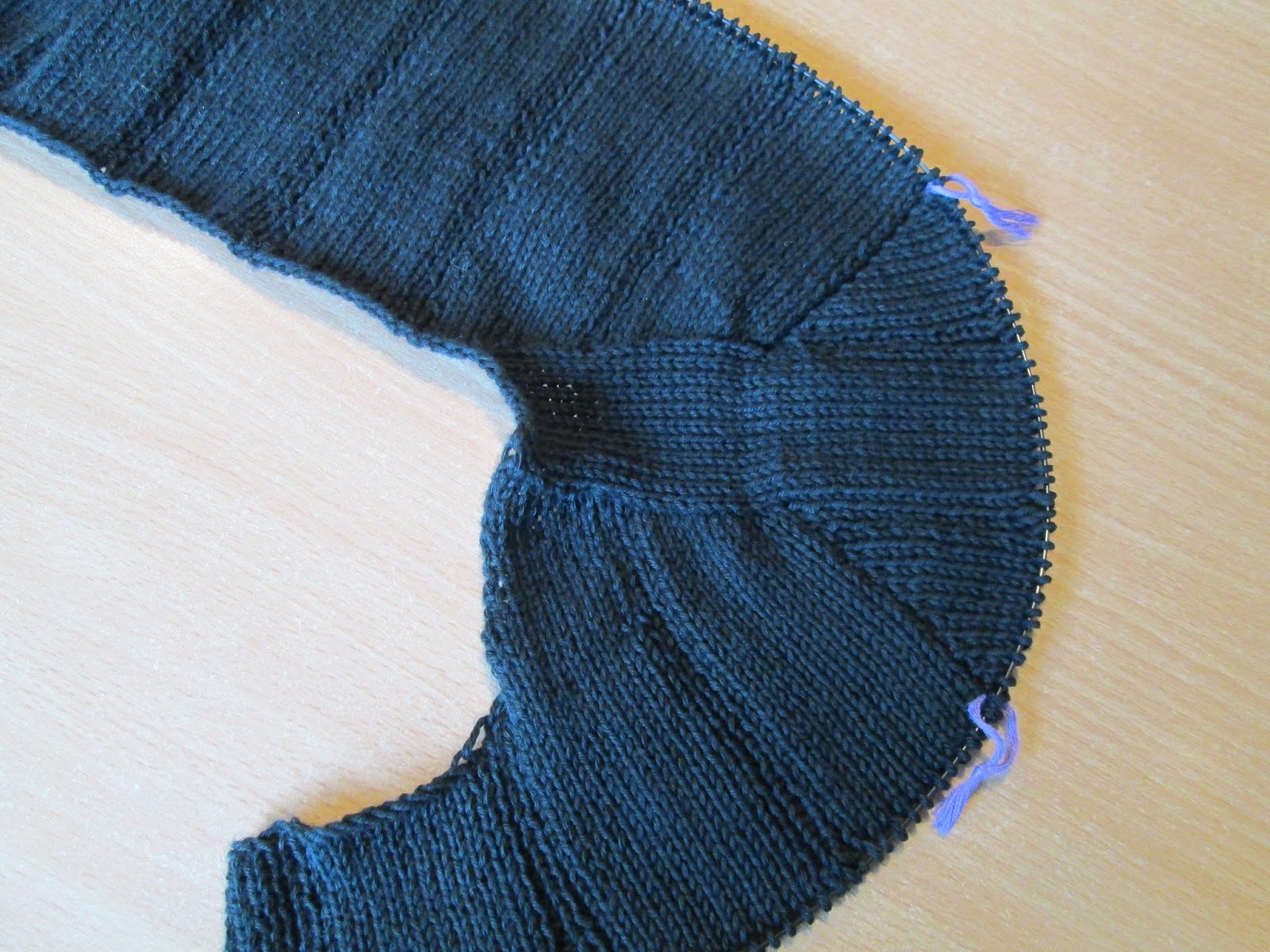
My current main project is a fingering weight cotton cardigan, an adult version of the Laura cardigan. The working title is Leaf cardigan because of the leafy lace border at the bottom – I do intend to come up with something more imaginative.

Anyway, I am once again using the contiguous sleeve method invented by SusieM, but with more shoulder stitches. On the driftwood 
jumper where I first encountered this method, you have two stitches running from the side of the neck to the shoulder, with increases on each side.
Now, that is all well and good – but it makes the back of the neck rather high, and my jumpers have a tendency to creep backwards over the shoulders. So, on the Laura, I made 7 shoulder stitches to give a bit more room for the back of the neck, and on this adult version, I have 11, making the shoulder somewhat resemble a saddle shoulder. The choice of uneven numbers is dictated by the stitch pattern I use for these cardigans: the leaf stem ribs are spaced by 11 knit stitches.

I am almost down to the divide for body and sleeves; the pattern is simple enough to be worked on while reading, so it is coming along nicely.


The Books
As mentioned last week, I have been listening to ChopBard on The Tempest, and of course reading the text of the play.
Apparently, this is a difficult play to pin down – what is it all about? Magic and the use of it, power over yourself and others, crime and retribution, redemption, revenge or forgiveness. As it is a comedy, nobody dies – though several characters are thought to be dead and/or fear for their lives – and a young couple are to be married.
There seems to be a line of critique that focuses on colonialism and slavery, simply because some of the characters are white Europeans (from Milan or Naples), landed on an island in the Mediterranean (not Bermuda) that was formerly only inhabited by the son of a North African witch. And this son, Caliban, is put to hard labour by Prospero, the duke-turned-magician.
I get the sense, once again, that particularly white US citizens want to interpret anything and everything in the light of a collective guilt over having used black Africans as slaves. Not that I would ever condone slavery as such – but it has been widely practised, historically and globally speaking, not only in North America, and not only by white people using black people.
Get over it. Shakespeare was not burdened by this guilt when he wrote his play, for very good reasons, so insisting on this interpretation is a huge anachronism.
And anyway, Caliban is the son of a Tunisian witch, not a Sub-Saharan black African, and he is a convict, not a slave. Prospero is punishing him for the attempted rape of his daughter, Miranda, who at the time of the play is 15 years old. Who can blame a father for that?

I mentioned to my boys what goes on in The Tempest: a storm and a shipwreck, people are thrown ashore on a magical island where strange things happen – and so, we decided to watch Lost again. The whole redemption or forgiveness theme in Shakespeare has resonances in Lost, as well: practically everybody, at least the main characters, are given a second chance to straighten up their lives and come to terms with themselves.

And, by the laws of synchronicity, I finally got started on the August group read in the Ravelry Book Club on Goodreads: The Night Circus by Erin Morgenstern. So, more magic and poetry – this is a lovely book.
The first named character to show up in the book is Prospero the Enchanter – stage name – and next, we meet his daughter who is very explicitly NOT named Miranda. Isn’t that great? See, if I had started this book sooner, say, around the beginning of August, those names would not have resounded the way they did for me.
Sometimes, the universe just aligns.


And on this happy note, I will leave you for now. Have a wonderful week, and I will be back with more chat on knitting, and yarn, and books, and students.
Take care!


Sunday, November 25, 2012

Words, Music, Colour


Hello, everybody, and once again welcome to the Apple Basket!

Considering the recent extreme weather across the pond, I cannot complain, but I will comment on the weather: it is windy, to say the least, and the rain is pouring down. The few leaves still trying to hang on are being stripped from their branches and thrown about. A perfect day for snuggling up on the sofa with a hot drink and some woolly knitting ... I will be going out in a bit, though: it is the last Sunday of the month and so time for the local knitting café.
This is also the day exactly mid way between the birthdays that mark the beginning of the festive season: Thomas was 17 last Sunday, and Andreas will be 19 next Sunday. I am continually amazed – how did I get to have boys that big all of a sudden?

But first, before I brave the elements, let me bring you up to speed with my recent exploits. There will not be a lot of knitting this time – after all, not so very much has happened on that front since Tuesday apart from progress on the wips – but instead talk about books, music and dyestuffs. And pictures.


Words, words, words

Sunrise above the clouds

 A Rhino parked outside Warhammer World

Lovely weather in Nottingham

The Ultra Marine guarding the elevators

For all these years, my main impression of Warhammer has been through the figures that Andreas collects, assembles, and paints. And very well, too, by the way; if he lets me, I’ll show you some one day.
I even at some point bought a set of three female warriors (I forget which), painted one, and never got round to doing more. Knitting makes so much more sense to me. And playing the board game doesn’t really appeal to me, either. I can see that it’s all about tactics, an elaborate version of something akin to chess; but still. Not my thing. Oh, well, to each his/her own.

But the bookish side of the whole thing should speak to me – after all, I have read vast amounts of books in all genres since I was five years old (not all genres at first, of course).
So, as I mentioned several weeks ago, I read the Eisenhorn Trilogy by Dan Abnett before going to the weekender – to find out a bit about what it’s all about and not be a total noob ...
And, to my vague surprise, I really liked it; getting into the flow and the ambience of the story, I found myself invested in the characters and hoping for their success.
I don’t know why it should surprise me, though: I’ve read tons of detective stories and sci-fi, and I’ll take Band of Brothers over Sex & the City any day of the week. So it’s not like this is an alien world to me, if you’ll pardon the pun.

Dan Abnett signing for Andreas
During our stay in Nottingham, I read First and Only, the first book in a series, also by Dan Abnett, called Gaunt’s Ghosts. These are war stories: brothers in arms, fighting in the trenches, being screwed over by armchair generals while battling Chaos enemies; stories of loyalty and bravery – or cowardice, in some instances. Andreas had brought this particular volume with him to be signed by Dan Abnett; it was the first Black Library book he ever bought, in Edinburgh in 2006. It is battered and coffee-stained, much read – and now signed by the author.
The hotel lobby was turned into a book store
 The event schedule was packed: in each programme slot were three simultaneous events, which called for some deliberation, prioritising and choosing. I let Andreas set the pace and just tagged along with my knitting – while, of course, soaking up as much as I could. Listening to a Q & A session with an author is always rewarding, even if you haven’t read any of their books.
And in this case, everybody is working within the same parameters – all the books are set in the Warhammer universe. A lot of the stories take place in the 40K part of it, including the ones I’ve read so far, which means that the time is around and after the year 40,000 A.D. (I use this denomination deliberately due to the religious nature of the civilisation).
Then there is the major event of the (relative) past, a galactic civil war named the Horus Heresy, which took place around 30,000 A.D. So far, 23 books of war stories have been published on this subject, and they say that they have about as many left to do. In-universe, the Horus Heresy is comparable to World War II: stuff happened, in this case thought out by the game masters of Warhammer; and a band of writers tell the stories of battles, treacheries, what happened with this or that legion of Space Marines, etc.

It seems from the way the authors and publishers – and artists, for there is a whole painter’s side to this, as well – interact, that a huge part of the loneliness of a writer is alleviated by this collaborative way of working. And, as Dan Abnett put it when asked about writing within a given universe: sure, you can make up your own world, but then you do have to make it all up, define all the rules. Most of his writing is about knowing the rules of the world he is writing in, and following them. The parameters are already there, be it Warhammer, Doctor Who, Marvel or Wallace & Grommit; you know, as a writer, what is possible and what is not. And so, you can concentrate on telling the story.


Lately, I’ve been mostly into sci-fi and magic in my reading: the Warhammer books, of course; and I listened to a new Doctor Who story, The Wheel of Ice by Stephen Baxter. This one features the second Doctor, with Jamie and Zoë – and it is read by David Troughton, the son of Patrick Troughton who played the second Doctor. Here, again, you have the whole writing-within-parameters: everybody knows the Doctor and his companions, when and where they come from, and how they look, behave and are likely to react to the unfolding events.

Having kids who read is a blessing – sometimes, I’m reading their books more than my own. Victor collects the Discworld series (by Terry Pratchett), and now I’ve read the second as well. I got him into the Dresden Files; I bought three of them months ago, he discovered the audio versions read by James Marsters (a.k.a. Spike from Buffy) and got them from Audible, and now we can actually get all of them on audio book here. So I am currently listening to the fourth Dresden File, Summer Knight. They are by Jim Butcher; the protagonist is the Chicago-based wizard detective Harry Dresden.
One of the great things about Audible is the way you can download your books any number of times; so if you access your account from someone else’s computer, you can download a book to their computer and so share audio books just like you would lend out a paper book. Oh, and they just introduced a Returns option – which I promptly used, having inadvertently downloaded an abridged version of Rose Tremain’s Restoration. I want the whole thing.


So, November. Or Movember, if you’re into moustaches. Or Wovember, if you’re in Britain and want to support the local wool industry – which I’m all for; no offence to New Zealand, but in this part of the world should be able to produce our own wool. Of course, I would primarily support Icelandic and Faroese wool, and Greenlandic.
November also means NaNoWriMo, the national novel writing month. I heard about this first on the CraftLit podcast; binge-listening as I do to old episodes, I have listened to Heather talking about her attempt at writing a novel in November 2008, and her success at doing it in November 2009.
I only found out that there is a Danish group when November had already begun, and anyway I am nowhere near ready to take on that challenge – writing a 50,000 word novel during the month of November – this year. But now I know about it, and I can practise my writing, and next year I can either not do Christmas knitting or plan ahead.


If music be the food for love ...

This past weekend, the music schools held their annual talent competition for young musicians. As I may have mentioned, my youngest son, Victor, plays classical guitar, and this was his first time to participate. The budding musicians have to have played their instrument for at least two years and be entered by their tutor; so it is not open for everybody.
Victor playing Prelude no. 4 by Heitor Villa-Lobos
The music school in Viborg, where we live, hosted the competition for the Mid-West area this year; and somewhere around 50 or 60 young musicians gathered to perform for the judges and audience during the Saturday. All day: from 9 a.m. to around 8 p.m. And one of the judges even had to go and do the same thing at another music school the next day. The set-up rather resembled X-Factor or American Idol with the three judges at the table and the performing musicians in front of them – except these judges do not have to contend with the clueless.

On the Sunday, there was a gala concert featuring those of the gold winners who had been selected for the finale this coming Sunday, when they will be competing against finalists from other parts of the country. After that, the diplomas were given out.
The scoring system awards bronze, silver or gold according to merit; everyone who participates is guaranteed at least a bronze diploma. This year, they said, they had raised the bar compared to previous years because of the high numbers of talented musicians. I must confess, that gave my insides a twist; waiting for the announcements was every bit as nerve-wracking as waiting for the result of an exam – and I was only excited by proxy! Victor had to perform Saturday morning and then wait until Sunday afternoon for the verdict.

In Victor’s group, the 10- to 14-year old soloists, they gave out 1 gold diploma, for a brilliant violinist, 4 silver diplomas, for Victor (yay!), one of his guitar buddies, and two others; and 8 or 10 bronze diplomas.
The silver for Victor was not a surprise (but it was still a relief to have it announced): he is very good, and he practises diligently – and willingly. I have never, in the four years he has played, had to remind or coax or threaten him to pick up the guitar. Or the ukulele. Or the banjo. Or the piano – well, he doesn’t pick that up, of course, but you know what I mean.
Next year, though, he will be in the older age group and will be competing not only against his two buddies, one of whom also won the silver, but against the older and more experienced musicians, including the 15-year old guitarist who won gold this year ... Oh, well, he’ll just have to keep at it. And no matter what comes out of it, the participation itself is a huge, confidence-enhancing experience.


Colour

My mother has been hinting about another scarf / shawlette being a good Christmas present, and confessed to wishing for a burgundy Haruni, when I asked her outright. So the blue Hitchhiker I was knitting for her was put on hold – she is my mum, after all – and I set out to make a red lace shawl.
Phase 1: some dyeing experiments to see if I could get a wine red. So on Tuesday, I set several dyestuffs up for soaking overnight: madder, brazilwood and logwood. With madder, I usually get an orangey red; brazilwood yields pink, and logwood abounds with blue or purple depending on the mordant. So some mix of those dyes might get me a burgundy.

And I made six 25 gram sampler skeins from the lovely, soft undyed Arwetta Classic sock yarn (80% merino, 20% nylon) to play with before getting into the real thing. I was going to mordant three with alum and three with copper and dye them two by two to compare the results.
I left everything to soak overnight and came back to it Wednesday morning – and found rust stains at the bottom of the pot for copper mordanting. Rust, as in iron oxide. Somehow, I had managed to not only not read on the jar, but to measure out, and stir while dissolving in the pot, pale green iron vitriol instead of bright blue copper sulphate without noticing. Brilliant.
Well, flectere necesse est, as they say, and nobody got hurt in the process. I adjusted my plans accordingly and went ahead.

There is a reason why treating fibre with iron is called ‘saddening’: the colours all become darker and greyer. 
Compare brazilwood on alum versus iron in the two middle skeins: pink and purplish grey.

These pictures are all of the newly dyed, still wet yarn hanging outside to drip.

Anyway, for the burgundy shawl I chose the madder-brazilwood-logwood combination with lots of madder, some brazilwood and just a bit of logwood to pull the colour from the orange towards the purple. 
I am quite pleased with the result, even though it may be a stretch to call it a wine red – it would be a very new wine, in that case!


So, that’s it for this week.
Have a great coming week, and I will look forward to chatting to you again soon. Until then:
Happy knitting!